
There’s a dramatic shift underway in the manufacturing of prosthesis. 3-D printing is slowly chipping away at restrictive barriers like money that have prevented thousands of people from taking advantage of prosthesis in the past, since hands can cost upwards of $10,000 per finger. Another barrier is access to electrical power, this issue in particular has been a major pitfall for anyone living in an area with a non-existent or unreliable power source. After talking to the folks at NOTIMPOSSIBLE Labs we started to think seriously about how we could help power these individual prosthetic hands–as well as the technology that creates them–from solar energy and what the performance might look like. Here’s what we came up with…
Role of Batteries in Current Prosthesis
Very broadly, there are two types of prosthetic limbs. Purely mechanical or body-powered limbs open or close without any sort of power assist. Myoelectric prosthesis sense nerve or muscle activity and are controlled by an external power source like a battery. Myoelectric prosthesis are more complicated and costly than purely mechanical arms, but the end result provides greater dexterity for the end user. The Open Hand Project is one organization that’s making the idea of a fully robotic, open source, 3-D printed hand a reality.
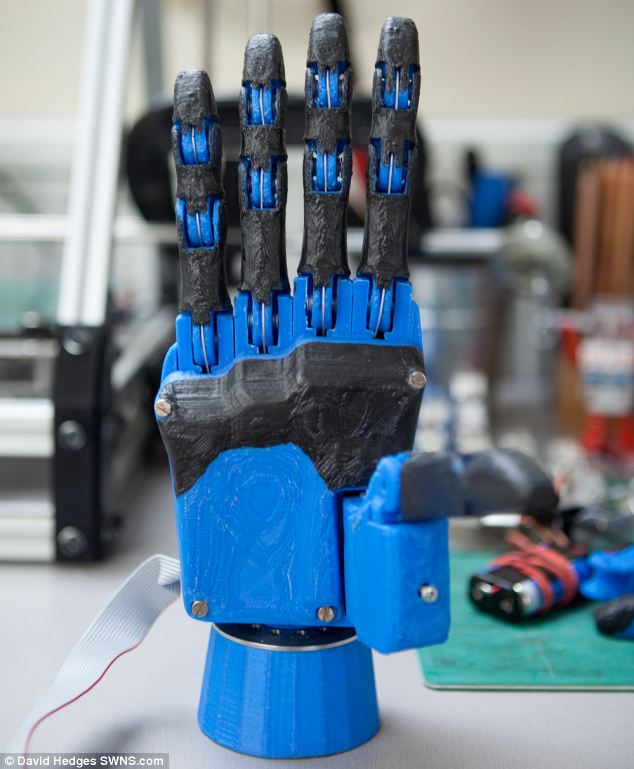 Openhandproject.org 3-D printed myoelectric hand. Openhandproject.org 3-D printed myoelectric hand. |
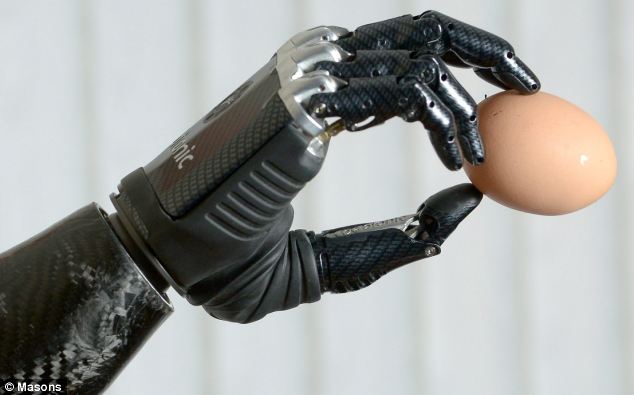 RSLSteeper bebionic3 myoelectric hand. RSLSteeper bebionic3 myoelectric hand. |
|---|
Capacity and Power of Batteries in Current Production Models
All of the batteries are 7.4 Volts and range in size from 9.6 to 17.8 Watt hours. The maximum current output of these batteries is 5 Amps or 37 Watts. As a point of reference, this is 3X what a high-powered USB port for an iPad puts out.
There is very little information about how long the batteries last in the wild. We’ve seen references to full day’s use under “normal” conditions using a 2200mAh battery, but don’t see any metrics quantifying what this really means in terms of number of hand open / close cycles, activities, etc.
| COMPANY | MODEL & RECOMMENDED BATTERY | VOLTAGE (working) | VOLTAGE (peak) | MAX CURRENT (amps) | BATTERY CAPACITY (mAh) | WATT HOURS |
|---|---|---|---|---|---|---|
| Touch Bionics | i-limb Ultra Revolution | 7.4 | 8.4 | 5 | 2000 | 14.8 |
| i-limb Ultra | 7.4 | 8.4 | 5 | 1300 | 9.6 | |
| i-limb (heavy use) | 7.4 | 8.4 | 5 | 2400 | 17.8 | |
| RSLSteeper | bebionic3 (w/ BBI-2200) | 7.4 | 8.4 | 5 | 2200 | 16.3 |
| bebionic3 (w/ BBI-1300S) | 7.4 | 8.4 | 5 | 1300 | 9.6 | |
| bebionic3 (w/ BBI-2200S split cell) | 7.4 | 8.4 | 5 | 2200 | 16.3 |
Battery Types in Open Source Projects
We’ve been unable to find concise details of the battery types used in open source projects–which makes sense because the major focus seems to be on purely mechanical prosthesis for the time being–but RC style LiPo battery packs with PCBs for over/under charge protection seem to be the most common in proprietary settings.
Opportunity for Solar Charging
If you live in the South Sudan, your options for charging a battery can be limited. Our tendency is to look for solutions that work from USB, but in this case it isn’t practical because the standard battery is 7.4V and requires a boost circuit (possible, but less efficient). Unless effective systems can be designed with smaller 3.7 Volt batteries, it makes sense to charge the prosthetic battery from 10-12 Volt solar panels.
For a reasonable level of performance, we think 7 to 12 Watts of power makes sense. In general, more power gives the user greater flexibility to charge their device and will keep them charged in less than ideal conditions.
Approximate Charge Time (assuming 14 Watt hour battery)
| SOLAR PANEL | HOURS |
|---|---|
| 4 Watts | 9 |
| 7 Watts | 5 |
| 12 Watts | 3 |
Making it work
There are lots of charge controllers for LiPo batteries. Their primary function is to prevent overcharging the battery or otherwise damaging the battery. Adafruit has an open source one for USB that could be modified for 7.4V batteries. There are also a range of LiPo RC chargers ranging in price from ~$9 to to well above $100.
We’d like to see a solution like camera charging where the battery slides into the cradle to minimize the moving parts and ensures a clean and stable connection. More important would be to see a standard connector across batteries so that it is easy to make the connection from charger to battery.
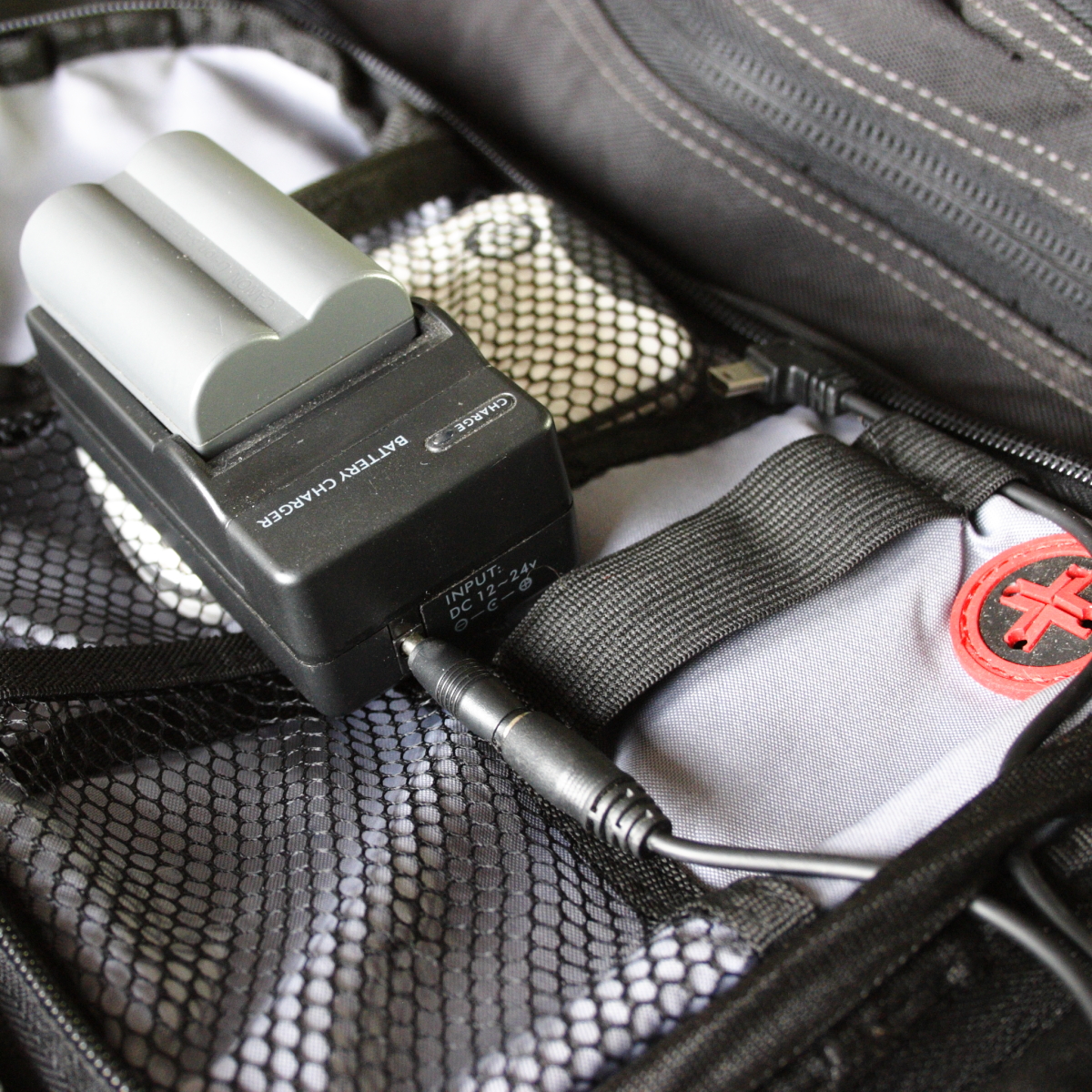 Typical Voltaic Systems camera battery charging setup. Typical Voltaic Systems camera battery charging setup. |
|---|
We will update as we learn more.
Leave a Reply