
Can you install solar panels facing a wall or tree? It depends on distance from the object, latitude and panel sizing!
For northern latitudes and taller buildings, the panels need to be further and further away from a given obstacle to see the sun. Choosing the right distance is critical for installation—a properly sized system won’t survive the winter if it’s installed too close to an obstacle.
In this blog I’ll show you how to calculate this crucial distance for your installation, then I’ll go into more detail about how those calculations are derived for my fellow nerds and engineers.
Calculating Distance
There are two distances that we’re concerned about in the graphic below:
H – How much higher the obstacle is than the panel? Precisely, the difference in height between the top of the obstacle and the bottom of the solar panel.
D – How far the panel is from the obstacle? Precisely, the horizontal distance from the most Northern tip of the obstacle to the most Southern part of the solar panels.
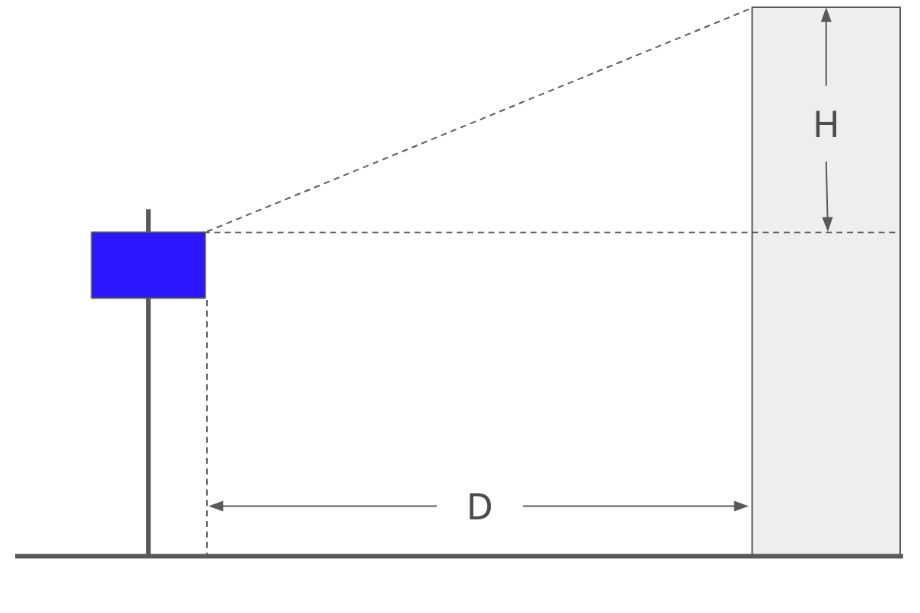
The Distance D is determined by a Multiplication Factor F. This changes depending on your location (see chart below). The further North you are installing, the further the panel will need to be away from the obstacle. Calculating D is simple:
D = F x H
| Location | Latitude | Factor (F) | Example Height (H) | Example Distance (D) |
| Zone 1 – Seattle, Bismarck | 45-50 | 6.85 | 10 ft | 69 ft |
| Zone 2 – New York, Boise | 40-45 | 3.51 | 10 ft | 35 ft |
| Zone 3 – San Francisco, D.C. | 35-40 | 3.11 | 10 ft | 31 ft |
| Zone 4 – Atlanta, Austin | 30-35 | 2.12 | 10 ft | 21 ft |
| Zone 5 – Miami, Houston | 25-30 | 1.89 | 10 ft | 19 ft |
Background
Voltaic sizes solar power systems based on their expected performance in December to ensure that the systems run year-round. December is when the sun is lowest in the sky and shadows are at their longest, so if you’re installing in June or July you can’t judge shadows with your eye.
At northern latitudes, a panel might only see the equivalent of 2 hours of direct sunlight over the course of the average December day. If the panel is shaded for the first half of the day by a building due South of it, then that installation will require double the amount of solar power. If that’s not accounted for during install, then the system will go down during the winter.
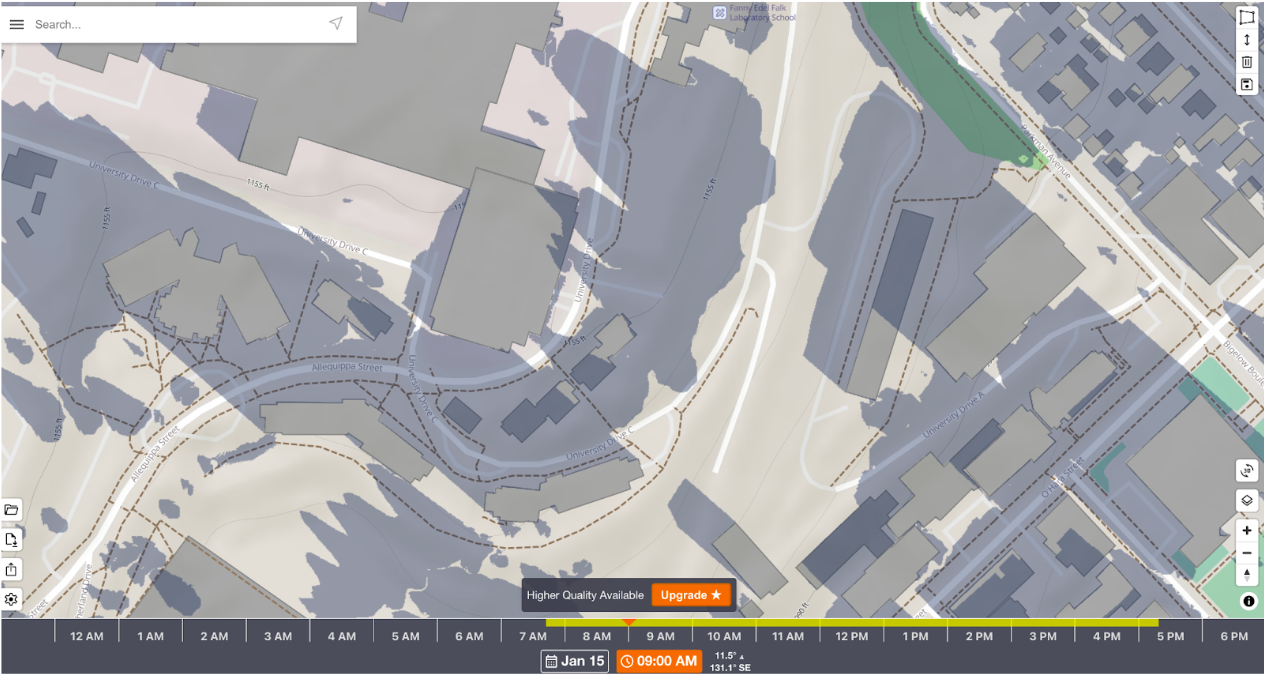
For the purposes of this exercise I assumed that the hours of 9AM – 3PM cover most of the significant sunlight hours in the wintertime. In other words, if you’re not shaded during these hours, then our estimates will hold up. This picture provided by Shademap.app shows the shading in Pittsburg at 9AM in early January to illustrate this point. If you use the factors in the table above, then your system will not see shading between 9AM – 3PM in your corresponding zone.
Math
To calculate the above multiplication factors, we took the height of the sun in degrees in December at 9AM as θ and plugged it into the following equation:
F = 1 / tan (θ)
Thank you for reading along and feel free to reach out if you are unsure about your installation location. We highly recommend using Shademap.app to check shading in your area.
Leave a Reply