
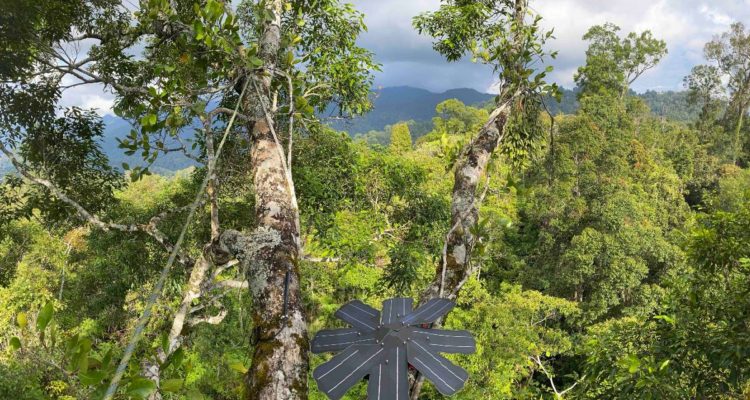
Rainforest Connection is a non-profit technology organization that creates acoustic monitoring systems to help end illegal deforestation and fight climate change. Voltaic Systems’ engineering team worked with Rainforest Connection over several months to create a custom solar panel array that generates 28 Watts and an iconic appearance that blends into the rainforest.
This post shows the design process for a new solar panel.
Rainforest Connection’s Guardian Acoustic Monitor
The RFCx Guardian is a custom developed acoustic device. It has a central computer running Android software. The system includes a highly sensitive external microphone that captures all ambient sound within a radius of up to 1500 meters, depending on the source of the sound.
Guardian streams real-time audio from the forest and transfers data in a number of ways, including streaming to the Rainforest Connection’s Guardian App (allowing partners to receive real-time alerts of threats such as chainsaws and gunshots). Acoustic data is also streamed to Arbimon, their free bioacoustics platform. Guardians have recently been updated with the ability to send data via satellite, allowing for coverage in areas with no GSM connectivity.
Challenges of Powering a Device in a Rainforest
A solar system for IoT devices needs to generate sufficient power to continually run the device. This can be challenging in open fields, but a rainforest presents many additional design and power challenges related to geography, weather, and animal interference. For example, in forest ecosystems, it’s necessary to place the Guardians very high in the treetops in order to capture adequate sunlight in the canopy.

Example of termites building a mount underneath Voltaic’s standard 9 Watt panels. This behavior didn’t affect the surface or wires of the panel.
The final criteria for the solar panels were:
- Be powerful enough to generate enough power in temperamental conditions
- Small enough for transport in small containers
- Light enough to install with one-hand
- Durable enough to withstand tropical moisture, temperature and UV
- Visually compelling and, ideally, echo the rainforest
Solar Panel Design Process
Voltaic started the process by experimenting with different shapes and colors. We were working with 5 and 3 busbar (5BB) cells which are 156mm wide and can be cut into columns of 31.2mm or 51mm wide respectively. Each drawing assumed roughly 2mm spacing between the cells and a minimum of 5mm between the edge of the solar cell and the panel edge.
Even though Voltaic was restricted by these physical limitations, there were a number of different designs that fit within the criteria. We started off by exploring large single panels as well as a series of “petals.”
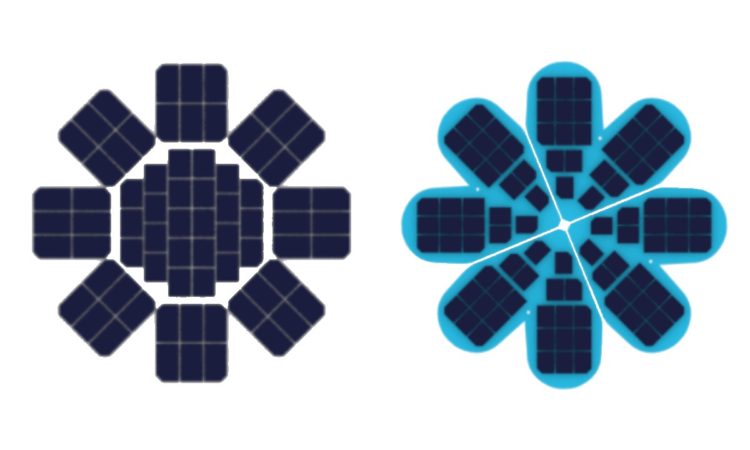
Round 1 Design
As we developed more understanding of the integration between the panels and the Guardian, we honed in on a 4 panel design with asymmetrical petals.
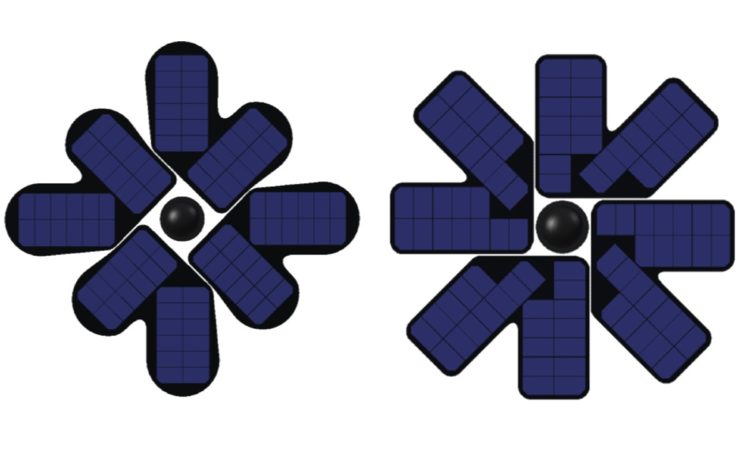
Round 2 Design
Finally, we added elements to echo the Cecropia tree and produced detailed technical drawings that could be used for production.

Detailed Mechanical Drawing of Solar Panel
Solar Panel Production Process
This solar panel uses a laminate production process. Voltaic first manufactures PCB to the correct shape.
Solar cells are then cut according to a specific pattern specified by Voltaic and then strung together using a stringing machine in seven and five piece strings. Voltaic tries to waste as little of the solar cell as possible in the cutting process.
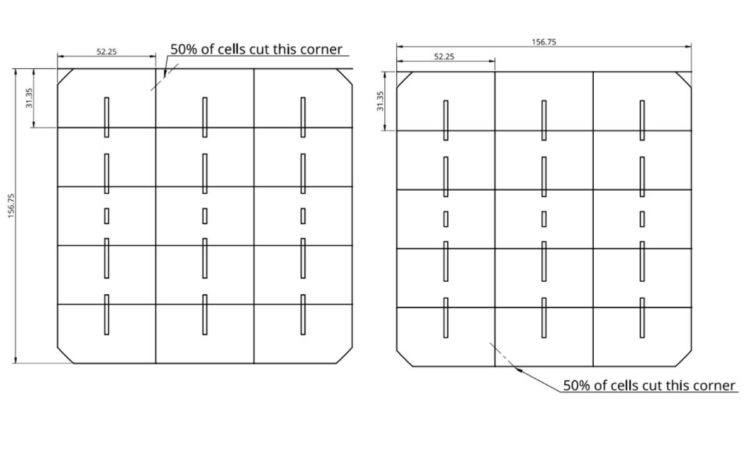
Cell Cut Diagram
These strings are then attached to the PCB and the panel is ready for lamination.
To laminate the panel, a layer of EVA (encapsulate for solar panels) is laid over the cells and then a polymer called ETFE covers the EVA. The panels are placed in a laminating press under heat and pressure to bond the four layers together.
The panels are then placed in a laser cutter to remove the excess material around the edge of the panel. The final step is to attach the wire and seal the connection with a silicone filled junction box.
Deploying Guardian Acoustic Monitors in the Rainforest
Guardians are currently deployed in over 12 countries on five continents. They are constantly listening to the forest and helping to protect against poaching, logging and other illegal activity.
Rainforest Connection delivers complete Guardian Systems with four solar panels in easy to carry cases around the world. Technicians and local partners ascend into the canopy, mount the Guardian and solar panels onto the custom bracket and the system is ready to monitor the forest.
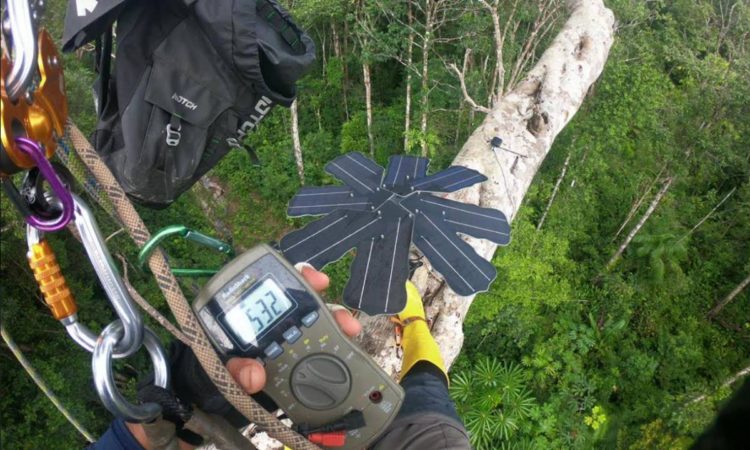
Guardian High Up in the Canopy
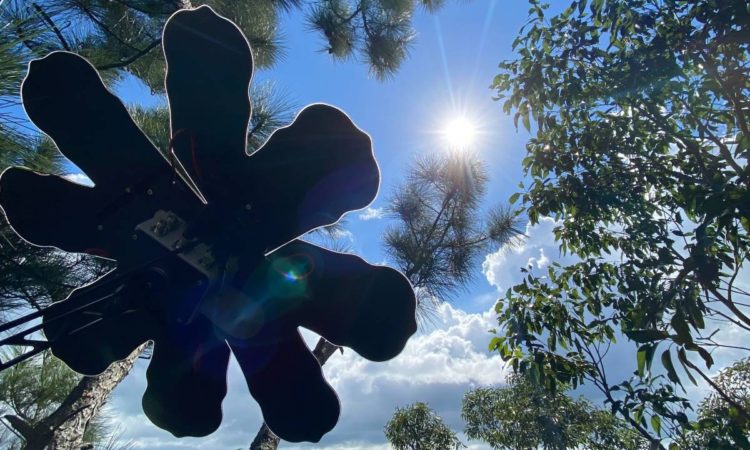
Guardian Deployed in the Rainforest
Providing enough power to the Guardian 24×7 in every season and environment is a big challenge. The Guardian regulates power consumption based on how much power is stored, how much power is being generated, and how much it expects to generate in the future. There are no less than 20 individual behaviors that must be adapted to those variables. Software controls everything, and Rainforest Connection relies on diagnostics, analytics and their ability to modify and change the behavior of the guardian software from a distance on the fly to continue to improve performance.
Learn more about Rainforest Connection and the work they do to protect rainforests here.
Leave a Reply