

This is a quick demonstration on how to power the BirdWeather PUC from solar power. The PUC listens to the sounds around it and is able to identify over 6,000 birds and many other non-avian species. It uses the BirdNET neural network from Cornell Lab of Ornithology and the Chemnitz University of Technology.
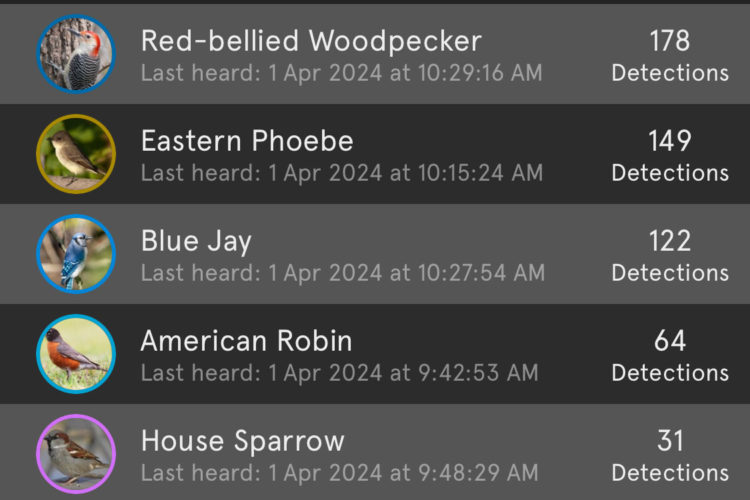
Here is some of the birds our device identified in the first days of deployment.
The PUC is simple to use and get started (especially compared to the raspberry Pi version) and is pretty power efficient. It consumes about 60mA at 5 Volts and improvements are underway to bring this down further.
We recommend most customers pair the PUC with our 5 Watt 5 Volt 35Wh solar power system. For customers in environments with less sun because of shading or northern latitudes or if you want to decrease the risk of your system going out of power, you can increase the panel size to 10 Watts in the drop down menu.
Quick math: 60mA * 5V * 24h = 7.2 Watt hours per day. In New York City, the 5 Watt system will perform well up until December. At that point, a south facing panel in will receive the equivalent of two hours of sun. After losses in and out of the circuit, it will provide only about 6 Watt hours to the PUC and it will likely have some down time. Doubling the panel size to 10 Watts gets us to 12 Watt hours into the battery and a more stable system.
The 5 Watt system includes a mounting bracket (BK102) which includes slots for u-bolts and screws. We simply used a few bolts to attach the panel to a steel post.
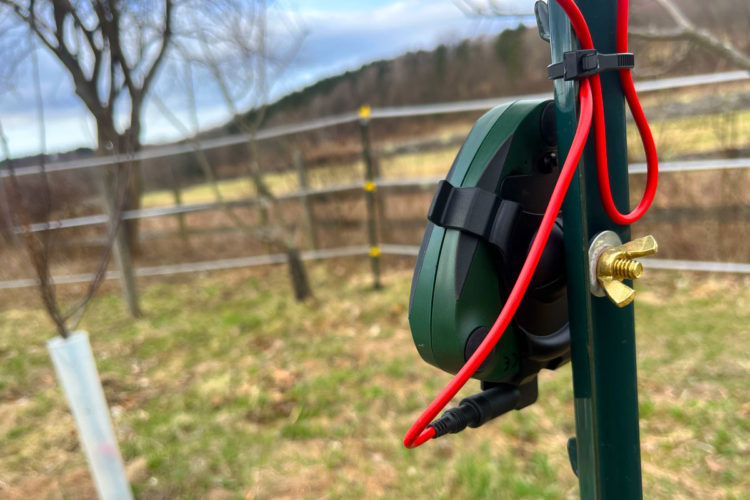
We placed the PUC underneath the solar panel. The back mount has a 1/4″ 40 screw thread. We attached a short piece of 1/4″ 40 threaded rod and a wing not to secure it to the post.
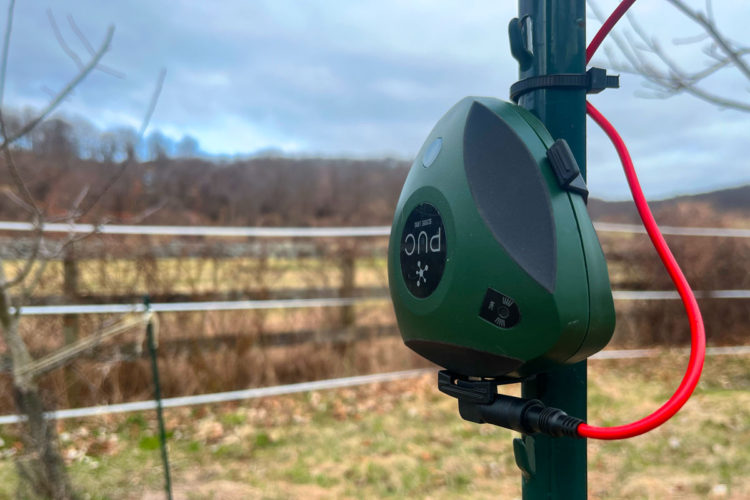
The V35 battery from the Voltaic system connects to the PUC via a USBC adapter (A123). That’s it!
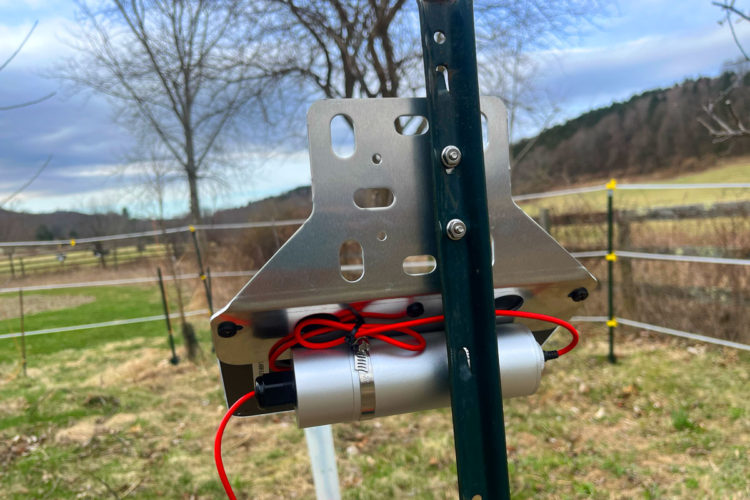
Another option is our systems with enclosure. This is the 5 Watt, 5 Volt system using the V50 battery. This system was deployed by Derek Rogers of the Adirondack Land Trust. 
Happy acoustic birding.
Do I need any additional accessories to connect the 5 watt system to the PUC?
No, all parts are included with the 5 Watt System.
What size panel and battery would you recommend for also running one of these https://broadbandsavvy.com/ee-mifi-review/
Trying to find a draw spec but this is the closest I’ve come Battery: 2150mAh, up to 6 hours
Hi Robert – it will take a bit of testing, but the site is saying the 2150mAh battery lasts 6 hours. That is equivalent to 32 Watt hours a day (2.15A*3.7V*4). It really pushes you up to one of our bigger systems, probably:
https://voltaicsystems.com/25-watt-12-volt-solar-power-system/
https://voltaicsystems.com/50-watt-12-volt-solar-power-system/
That would give you closer to 7 days battery life, vs <2 with a V75.
There are other options for cellular wifi and it would be good to find a way to power optimize it as it feels pretty ungainly for such an otherwise small and energy efficient device. Maybe there is a way to have a have a router sleep and update once an hour and then go back to sleep.
Do you have any recommendations for cellular wifi devices? I have this exact set up but it’s hard to manage the upload time it takes to bring it in and upload it. Would be nice to have a complete set up for remote that can remain live
There are a lot of options and it can get complex.
I would look first at the amount of data the PUC generates and how that translates to a monthly data plan.
In general, our preference would be something like the Teltonika RUT241 in a waterproof enclosure. We have seen people using USB sticks, but I can’t vouch for them in terms of long-term reliability.
Power consumption of these devices tends to be in the 1 watt plus range so it likely pushes you up to the 25 Watt or 50 Watt CORE system in terms of sizing. I would measure the power consumption of the USB device prior to making a solar purchase.