
In discussions with customers, we often suggest they purchase a solar irradiance meter. We believe it is critical to testing any solar panel or, more importantly, the performance of a solar panel in conjunction with a storage element like a battery.

Mount your solar power meter along the same axis so that you are measuring the intensity of the light falling onto the panel. Note that even a small discrepancy in the angles can throw off your experimental results, so you’ll want to make sure that the panel and the solar meter are closely aligned.
Visible Brightness vs. Available Solar Power
In my first week at Voltaic Systems, we placed a solar meter to measure the available energy in Watts per m^2 at different points on my desk, along the window sill, in the middle of the room, and even just outside the window:
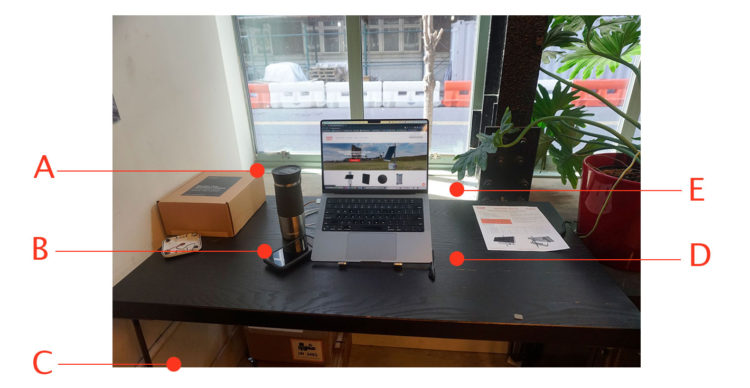
| Letter | Location | Solar Irradiance |
|---|---|---|
| A | Near Window Left | 3.8 m^2 |
| B | Computer Left | 1.5 m^2 |
| C | Chair | 1.0 m^2 |
| D | Computer Right | .5 m^2 |
| E | Near Window Right | 30 m^2 |
| F | Outside | 620-1000m^2 |
In each case, the light looked similar to our eyes, but the amount of energy that would be available to a solar panel was vastly different. The values captured were much lower than I expected and a fraction of the same light that I measured just outside the window. The lesson here is that you can’t trust your eyes to gauge how much light is hitting a solar panel. You need a tool to measure solar energy to determine if there is enough to power your device.
Circuit Testing with a Solar Meter
Given the variability of the available energy, we recommend using a solar meter whenever taking power readings from a solar panel. This is important for several reasons:
- It will allow you to scale the output to a “full sun” – let’s say you measure the output of the solar panel at 950 W/m^2 instead of full sun of 1,000 W/m^2. You can then take that value, multiply by 1.053 (1,000/950) and you will know what the system generates in full sun.
- You can compare readings across different days, months and years.
- You will be able to compare power flow into your circuit relative to the expected value. If your panel has an expected power of 1 Watt and you are only delivering 0.5 Watts in full sun, then there is an issue in your design.
- You can test whether power production scales linearly as light level decreases. You should see roughly 1/10th the power generated by the panel at 100 W/m^2 as you do at 1,000 W/m^2. If you don’t, there is an issue.
What is a Solar Meter
So what exactly is a solar meter? Solar meters are also known as pyranometers or solar irradiation testers, and they are used to measure solar irradiance.
Let’s backup a moment and define some terms. Solar irradiance is power of solar radiation from the sun per unit area and is measured in Watts per meter2 (W/m^2). Solar insolation, or solar irradiation is the total amount of energy that an area receives over a certain interval of time and is measured in Watt hours per meter2 (Wh/m^2). Solar radiation is the energy emitted by the sun itself. Here’s a good way to think about it: Irradiance is received, while radiation is emitted.
Causes in Variation of Solar Radiation
The amount of solar radiation that reaches any one spot on the Earth’s surface varies according to:
- Geographic location
- Time of day
- Season
- Local landscape (think shading)
- Local weather
Above the earth’s atmosphere where there is no diffusion, irradiation has an intensity of approximately 1380 watts per square meter (W/m^2). This value is known as the Solar Constant. Sunlight that is not diffused is known as direct beam solar radiation. At the earth’s surface on a clear day at solar noon in the summer months the value is approximately 1000 W/m^2. As sunlight travels through the atmosphere, it can be diffused by the following factors:
- Air molecules
- Water vapor
- Clouds
- Dust
- Pollutants
- Smoke from wildfires
- Ash from volcanic eruptions
Diffusion can reduce solar radiation by 10-100%. This is why under a hazy summer sky, we don’t get a measurement of 1K Watts (full sun), but instead see readings between 850W and 950W.
Tools to Measure Irradiance
A solar pyranometer measures the amount of solar radiation received by a surface. It consists of a sensor that is sensitive to the full spectrum of solar radiation, from ultraviolet to infrared, and a device that converts the received radiation into an electrical signal. The electrical signal is then processed and displayed as a measure of solar irradiance.
Higher performance pyranometers use a thermopile detector element to convert thermal energy (heat) into electrical energy. The voltage signal produced by the pyranometer is linearly proportional to the solar radiation received at the thermopile detector surface level.

Apogee’s Thermopile Pyranometer
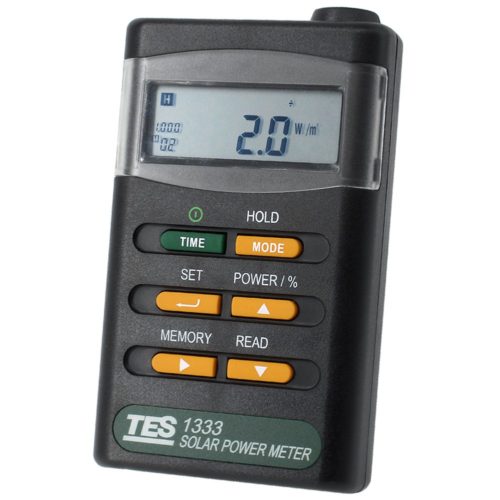
There are lower cost / lower performance pyranometers, like the TES 1333 we use, which employs a silicon photodiode detector instead of a thermopile detector element. We calibrate this light meter against lab tested panels and find that the accuracy is sufficient in most of our testing situations. The silicon cell pyranometers are based on the photovoltaic effect and use semiconductor materials, like silicon, to convert solar radiation into electrical current. The spectral response range of Si-pyranometers is limited though, typically between 400 – 1100 nm. While limited, the advantage to Si-pyranometers is that they are small, lightweight, and can measure direct and diffuse solar irradiance.
Both thermopile pyranometers or photodiode pyranometers are more accurate and more expensive than the silicon cell pyranometers, and Pyrheliometers, which measure only direct solar radiation, are even more accurate, but are also more expensive and more difficult to operate.
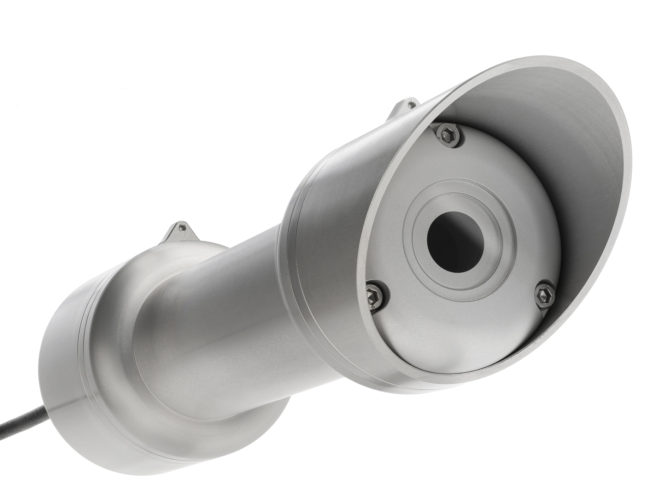
Between a pyranometer and a pyrheliometer, the latter is better at measuring solar irradiation and sunshine duration, but the pyranometer is better at measuring light in overcast conditions when the solar radiation is diffused.
When purchasing a solar meter, look for its measuring range, resolution, range of accuracy, cosine correction, portability, and durability. Since you will be taking several readings, you may also want to consider a meter that has a memory function to record all your data.
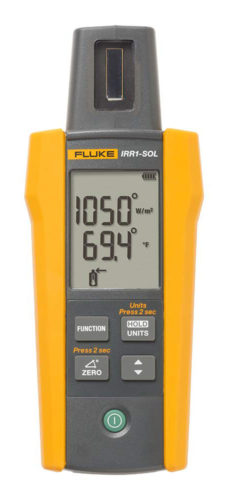
Fluke IRR1 Solar Irradiance Meter
- Measuring range: 0 to 1400 w/m^2
- Measure and document panel orientation and inclination
- Runs on 4 AA batteries
- ~$365
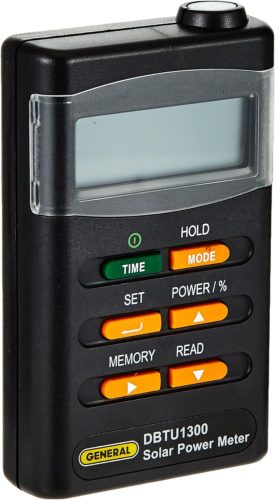
General Tools Handheld Digital Solar BTU Power Tester Meter
- Measuring range: 0 to 2000 W/m^2
- Current time setting, automatic transmission of measurements and data logging of up to 99 readings, as well as min/max/Avg memory + data Hold and auto power off (can be disabled).
- Stable light sensor with a wide spectral range (400-1100nm) and a sampling rate of 4 times/second.
- Records min/max/Avg
- Runs on 4 AAA batteries
- ~$101
Oumefar Digital Solar Power Pyranometer
- Measuring range: 0.1-1999.9W/m^2
- Resolution: 0.1W/m^2
- Does not need to be calibrated
- Supports maximum value hold function and data hold function
- The maximum value hold function allows you to capture the highest measured value and the hold function allows you to freeze the displayed value.
- Runs on 1 9V battery
- ~$75
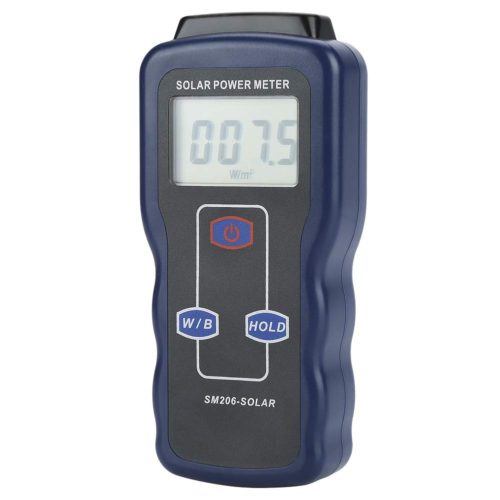
- Measuring range: 200.0 -2000 W/m^2
- Resolution: 0.1 W/m^2 -1 W/m^2.
- Provides datalogging
- Runs on 6 AAA
- ~$239

- Measuring range: 0-2000 W/m^2,
- Resolution: 0.1 W/m^2
- Runs on 4 AAA batteries
- $162
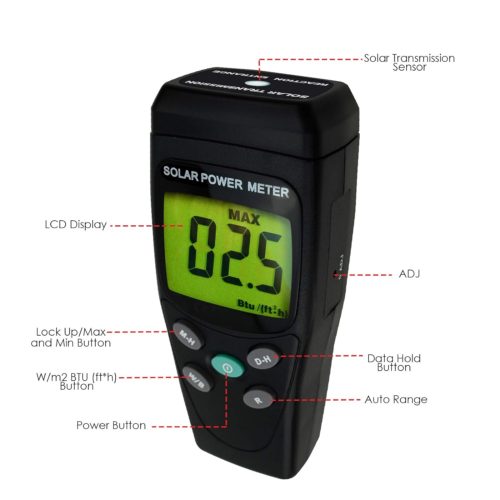
Tenmars Handheld Digital Solar Power Pyranometer
- Measuring range: 0-2000 W/m^2
- Resolution: 0.1 W/m^2.
- Shows up to 2000 readings.
- Built-in solar transmission sensor for added accuracy.
- The Data Hold function allows you to freeze the maximum and minimum readings.
- The LCD display ensures easy visibility even in bright sunlight.
- Runs on 1 9V battery
- ~$85
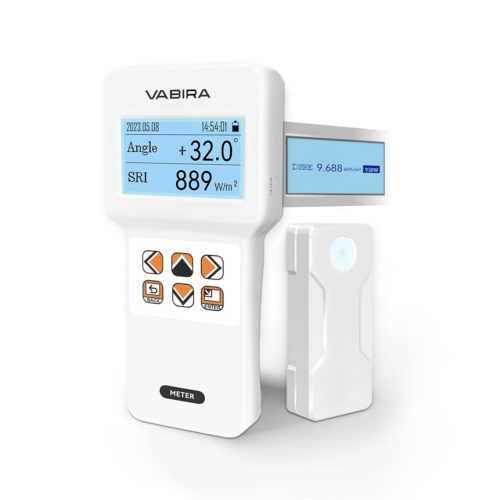
VBR-SOL Solar Irradiance Meter Daily Solar Radiation Energy Record
- Measuring range: 0– 3499 W/m^2
- Records tilt of panel
- Runs on 3 AAA batteries
- ~$100
Unless you are doing very low light testing, the more economical light meters will be a good place to start and we promise it will improve your design process.
Leave a Reply